

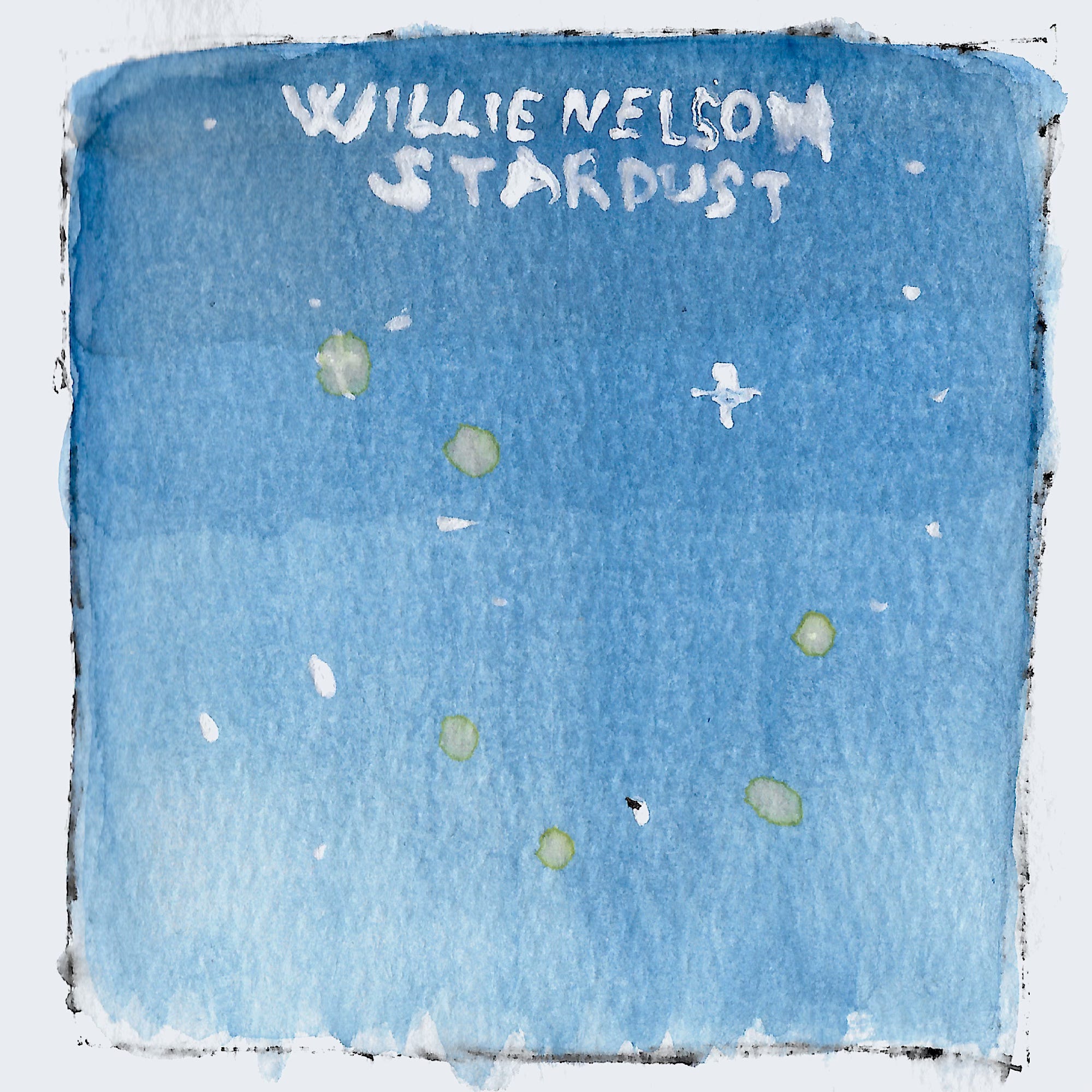
Stardust
Willie Nelson; "Unchained Melody"; from my parents' collection

People, especially older people in the world of musical theater, refer to the Great American Songbook and—the way they talk about it—you’d think it’s a literal tome somewhere. Probably, at this point, a series of shelves rather than just one bound volume. It’s a loosely-defined canon of influential American popular songs and jazz standards, primarily composed from the 1920s through the 1950s–60s, written by professional songwriters. If you want to be fancy and high-art about it, you can think of this as America’s answer to classical music. Europe invented the form; America did their own thing and popularized it, made it shiny and accessible to the masses.
A standard in the songbook is defined as much by its afterlife as by its original performance. These songs have outlived their authorial intent, and have become basic repertoire for the enterprising young musician. A song like “My Funny Valentine” or “Summertime” is a vehicle for expression, a medium-unto-itself, rather than a piece that people will perform over and over with the same rigidity and fixed form. Someone can do a straight-ahead version and lean into their vocal prowess or instrumental chops, doing subtle differentiation that way; another performer might totally reinvent the piece by simply using the chord changes and melody as a basic skeleton: “My Favorite Things” comes to mind.
The question is, what possesses an artist to work in this mode? Why do a record of the Great American Songbook when you’re already popular?
That’s a question for Willie Nelson. By the mid-1970s, Nelson was one of the figureheads of the Outlaw Country movement, a reaction against the overproduced, string-laden Nashville Sound (which was maybe inflected with some of the Tin Pan Alley approach to orchestration, but I digress). He was fresh off Red Headed Stranger, which was lean, cinematic, and critically adored. The record executives wanted more of this. But Willie wanted to go a different way.
He picked out some stuff Frank Sinatra and Ella Fitzgerald built careers on, which was decidedly unrelatable for the zeitgeist of 1978. Punk and new wave were reshaping rock, disco was peaking, and country’s commercial inertia was very specifically in what he had done before.
He talked to his buddy Booker T. Jones and then put together a close-miked classically 1970’s sounding studio record, leaning into the production aesthetic of dry and direct—people playing together in a small room without a wash of plate reverb or echo chamber. The harmonica wouldn’t sound out of place on a Stevie Wonder record. And it’s not just the production choice that makes Woody’s voice sound so unique, so distinctly idiosyncratic. He always had good musical phrasing in the country world, but the facility he had with jazz surprised listeners. Woody could swing.
As a result, the album broke through to audiences that had never bought a Willie Nelson record—pop listeners, jazz fans, older Americans nostalgic for these songs. It reached No. 1 on the country charts and No. 30 on the Billboard 200 overall, and eventually went quadruple platinum. It might be the best selling record of his career—the internet can’t seem to decide that one.
Do I like the music? Not necessarily; much of it is not for me, because I was not born in the generation that came before the Silent Generation. Woody does have a good voice, and the arrangements of the songs are totally serviceable, but would I rather hear some kind of song about gunslingers and dastardly deeds in the Old West over a campfire guitar? You betcha.
Do I like the record? Conceptually? Am I enamored with the idea that a person at the top of their game can go with their gut, displaying a brazen middle-finger to the institutions they made their career on, and get the population on their side?
Hell yes. Always an outlaw.
Verdict: Keep
How do you feel about the Great American Songbook?