


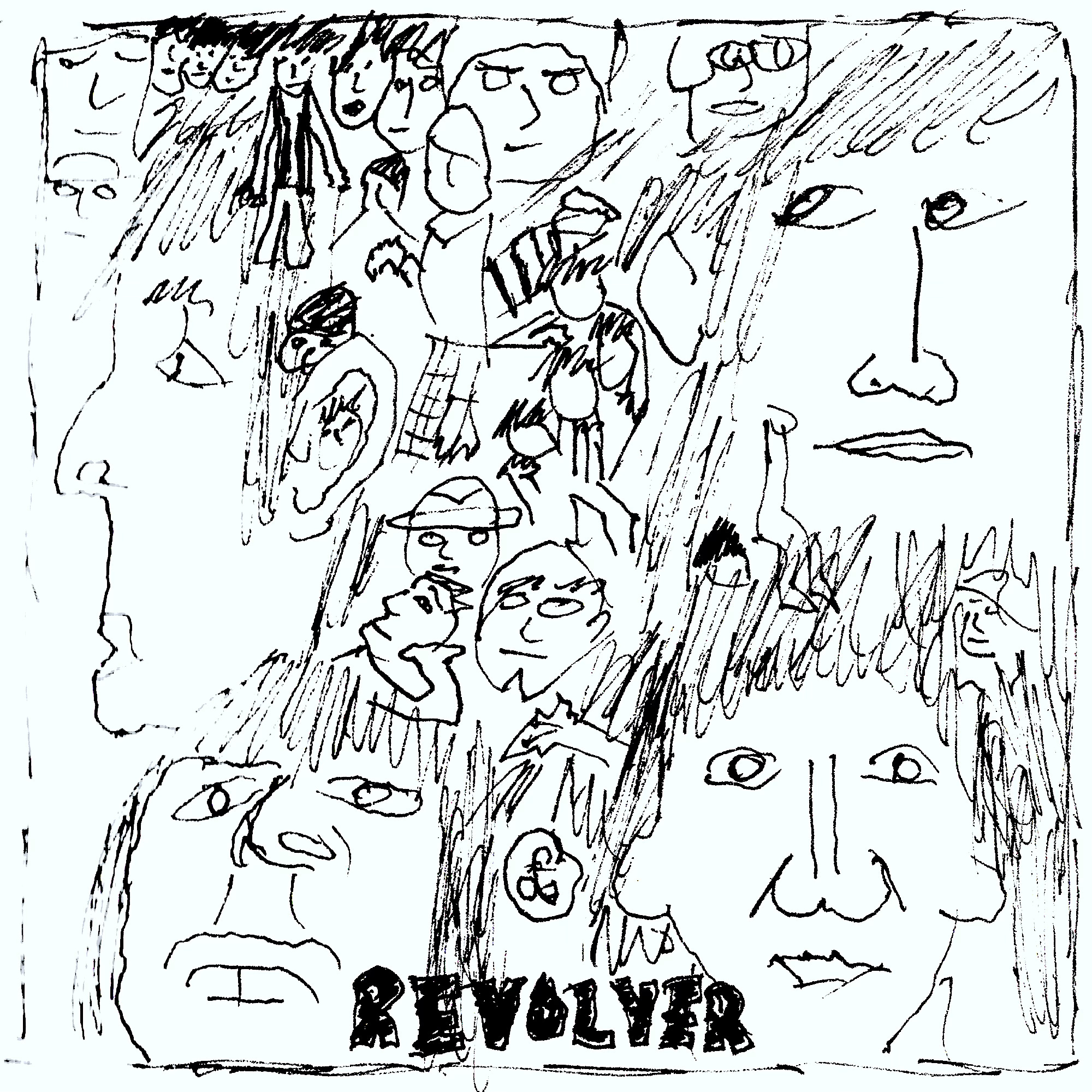
The most perfectly executed compilation of music doesn’t exist—except for Revolver by The Beatles. It’s hard to say that without sounding hyperbolic, but this album does so many things right. Revolver manages to be playful and strange, virtuosic and silly, political and intimate—all within the tight frame of 35 minutes. No song overstays its welcome, and no moment feels like filler. Essentially every artist writing in a pop context aspires to this kind of greatness.
I discovered Revolver as a teenager, digging through the plastic and bakelite storage shelves of old records my parents kept under the stairs in the basement. Before children, before me, they liked to take a small boat out on the lake. They kept their nautical diagrams and ship’s compass down there next to the records; relics of a past life. In my search, I sailed past the early Beatles records—Please Please Me, With the Beatles—and went straight for the ones with color and mystery. Of course, Sgt. Pepper came first, but Revolver came next.
There’s something about the album which produces a deceptive modesty. Maybe it's the black-and-white cover art, but it doesn’t announce itself as a revolutionary artifact, and yet it was—and still is.
The studio trickery behind “Tomorrow Never Knows” practically invented electronic music, or at least pointed the way toward genres like trance and ambient decades ahead of schedule. The song, famously difficult to reproduce live, essentially marked a quiet end to the Beatles as a live act. From this point on, the studio was their instrument. It’s easy to forget how radical that was. Built on a single droning D chord, it feels more like a sound ritual than a song. Lennon’s voice—flattened, filtered, alien—chants lines adapted from The Psychedelic Experience over tape loops, reversed guitar solos. The band wasn’t playing together in a room anymore; they were constructing something that could only exist in the studio.
“Tomorrow Never Knows” couldn’t be played live, not in any traditional sense. It marked the beginning of a shift in what the Beatles could be, what a recording act could be. It was a radical gesture: not just a rejection of the pop formula, but a vision of something we now recognize as proto-electronic, proto-sampling, proto-trance: proto-everything.
Perhaps because I was born when I was, but this record did not shatter my sense of what music could be. Stylistically, everything had already been upended, and I was discovering music in the aftermath—I was listening to Revolver contemporaneously with krautrock and electronic music and finding other things on the internet. But I was still impressed by the contrasts in the songwriting. There’s political commentary here (“Taxman”), but it’s sly, not strident—at least for an American audience. There’s experimentalism, but it never feels like homework. And of course, commentary on the everyday with “I’m Only Sleeping,” a song I would try to cover later. That balance—between invention and listenability—is the Beatles at their most confident and self-effacing.
I began to put together my thoughts about this record once while sitting in the symphony hall, feeling both inspired and dwarfed by the classical repertoire around me. Unlike much of that music, Revolver doesn’t ask to be revered—it’s human-scale. It pairs experimentalism with accessibility, weaving backward tape loops and Indian classical instrumentation into radio-ready pop songs. It shifts from “Eleanor Rigby”’s stark chamber despair to the wide-eyed wonder of “Here, There and Everywhere” without breaking stride. Every track feels like a window into a different songwriter’s consciousness.
What I love most about Revolver, now, is how symmetrical it feels: a record where innovation happens in all directions. The songs rotate authorship between Lennon, McCartney, and Harrison. And Ringo’s even on there with one of his big hits “Yellow Submarine”, showing us that the idea of what a pop song can be is constantly turning over. In that sense, it lives up to its title. It's a revolution, but also something that keeps turning.
Verdict: Keep
Do you all live in a yellow submarine?