

Music for 18 Musicians
Steve Reich; "Section V"; Purchased from Discogs

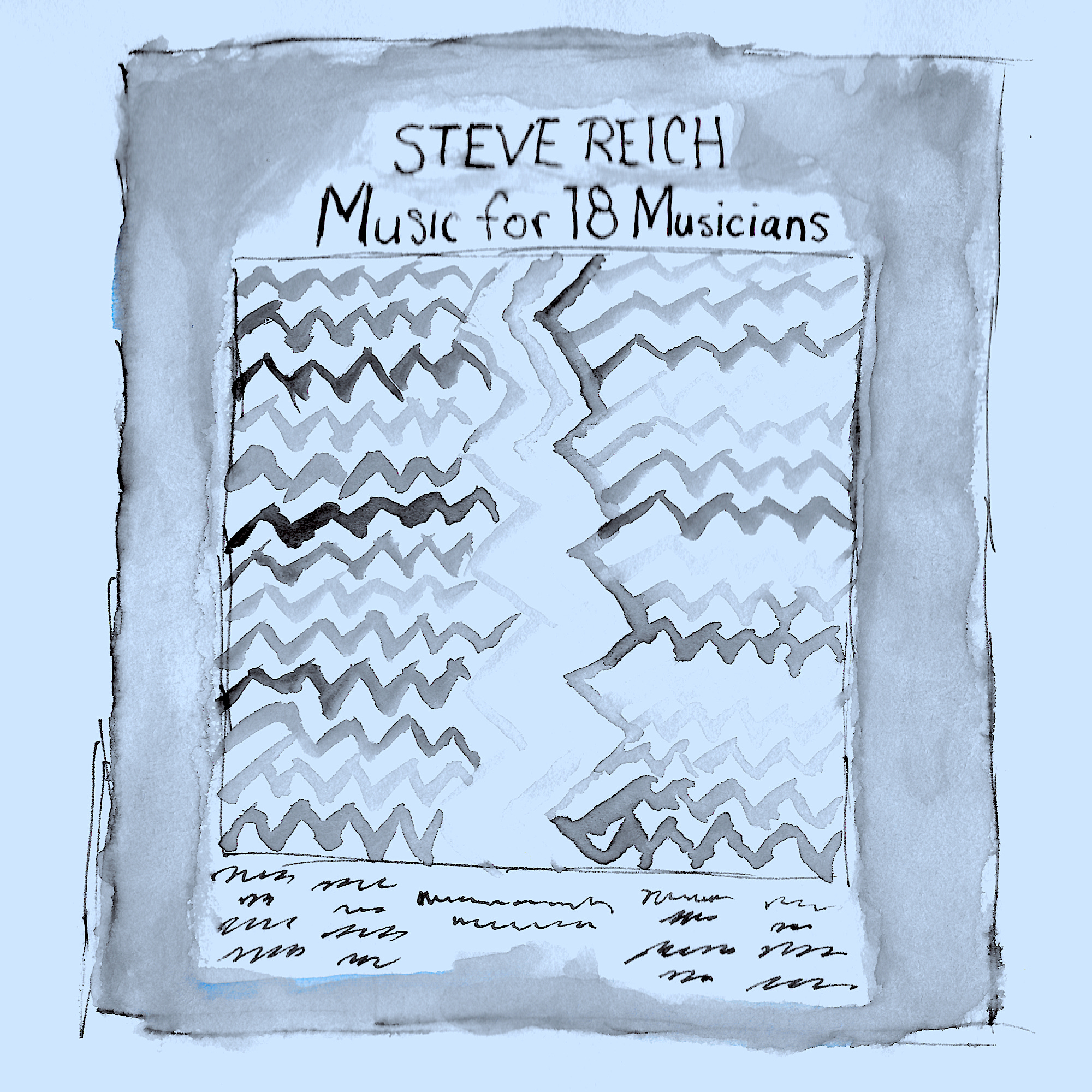
Like so much other music that is important to me, I first encountered this piece through a post on a message board. I was in high school then, deeply fascinated by jazz’s dense chordal and melodic structures. This was something else entirely—microscopic and macroscopic at once, a rippling sheet of sound stretched across time. Maybe it tapped into the same outside-of-rhythm pulse and interlocking patterns that form the core of my inner musical language, similar to what Dawn of Midi would do for me years later.
Reich’s name kept surfacing in interviews with artists I admired: Sufjan Stevens, Radiohead, and nearly every other classical-inspired modern singer-songwriter of repute. Naturally, I dove in, devouring this piece. Like people who watch a lot of movies think they can direct, those few intense years of listening gave me the false confidence that I might have the chops to become a composer myself.
So in my sophomore year of college, I decided to try. I signed up for composition classes and music theory, only to discover that the composition I was curious about wasn’t just about notes on a page. Reich’s music was born from processes and performance (he famously worked with cut up, looped tape on some of his early works), but replicating that when you’re writing Bach chorales and doing simplistic voice leading proves to be a mismatch of intention. I thought I could wrestle this new language into something coherent—at the time, I could sight-read music decently well; a skill long since lost.
I remember the moment that I placed my hand on the score for this piece, pulling it out of the short stacks on the second basement tier of the music library. It was a small book, bound in matte burgundy, elegant typesetting of all the dots and lines on the staves. Sense-memories tell me the weight of the paper was heavier than expected; I took it out and poured over it on my extra-long twin bed. I tried to read both vertically and horizontally, understanding the interlocking parts, the phrasing, the phasing. It was lost on me.
I was out of my depth trying to make my way through it by myself. I gave up on reading it, and then gave up on traditional composition soon after.
But I could still cosplay in the classical scene: there would be a special weeklong concert series to honor Steve at my university, and the university orchestra would perform works from the same era, like Terry Riley’s “In C”. On a Friday afternoon, I got to see him speak about his biography and his career from the back of the auditorium, having skipped my Mexican cinema class. My friends and I got tickets to watch him conduct “Six Marimbas” and “Drumming” and an excerpt of “Clapping Music,” and we all pretended we understood.
I pivoted, electing to take some graduate-level music classes focused on computer-based composition. I loved the idea of systems thinking being brought to bear on the art world—mathematical, mechanical, technological. Computers, synthesizers, and electronic pulses were just as integral to this world as traditional orchestration. We used a piece of software called Max/MSP, which was my initial foray into user interface design.
Through happenstance I joined the musical pantheon with some of my heroes. It turns out the professor I was learning from had studied at IRCAM and with Nadia Boulanger, connecting me indirectly to Reich through his contemporary Philip Glass. I’m now in the same musical-intellectual genealogy, once-removed, as so many 20th century luminaries: Quincy Jones, Aaron Copland, Burt Bacharach. I’m sure she had students that went on to do nothing with music, perhaps the scions of wealth and industry of midcentury Paris, remittence men and wayward daughters of the dilettante jet set. I’m probably more like those folks than any of the brand-name musicians you’ve heard of, but either way, the bridge between you and the greats isn’t as wide as you think.
Eventually I would use my middling orchestration skills to write a string part, never played, for a record my friends and I made in our last year of college. To augment the instrumentation of the songs we wrote, we would sneak into the rehearsal space or the percussion studio and play the instruments as if they were our own.
After hours, we made a joyous, shambolic sound, and in at least one arrangement, there is a direct homage to arpeggios in 18 Musicians, played on vibraphone by my dear friend PM, the song written by JK about the sad impossibility of a relationship he wanted to build with someone. Sometimes, paradoxically, giving up our dreams lets us pursue them via other avenues.
Verdict: Keep
Any tangential connections you have from historically-noteworthy people?