

Little Deuce Coupe
The Beach Boys; "A Young Man is Gone"; found on a street corner when someone was throwing it away

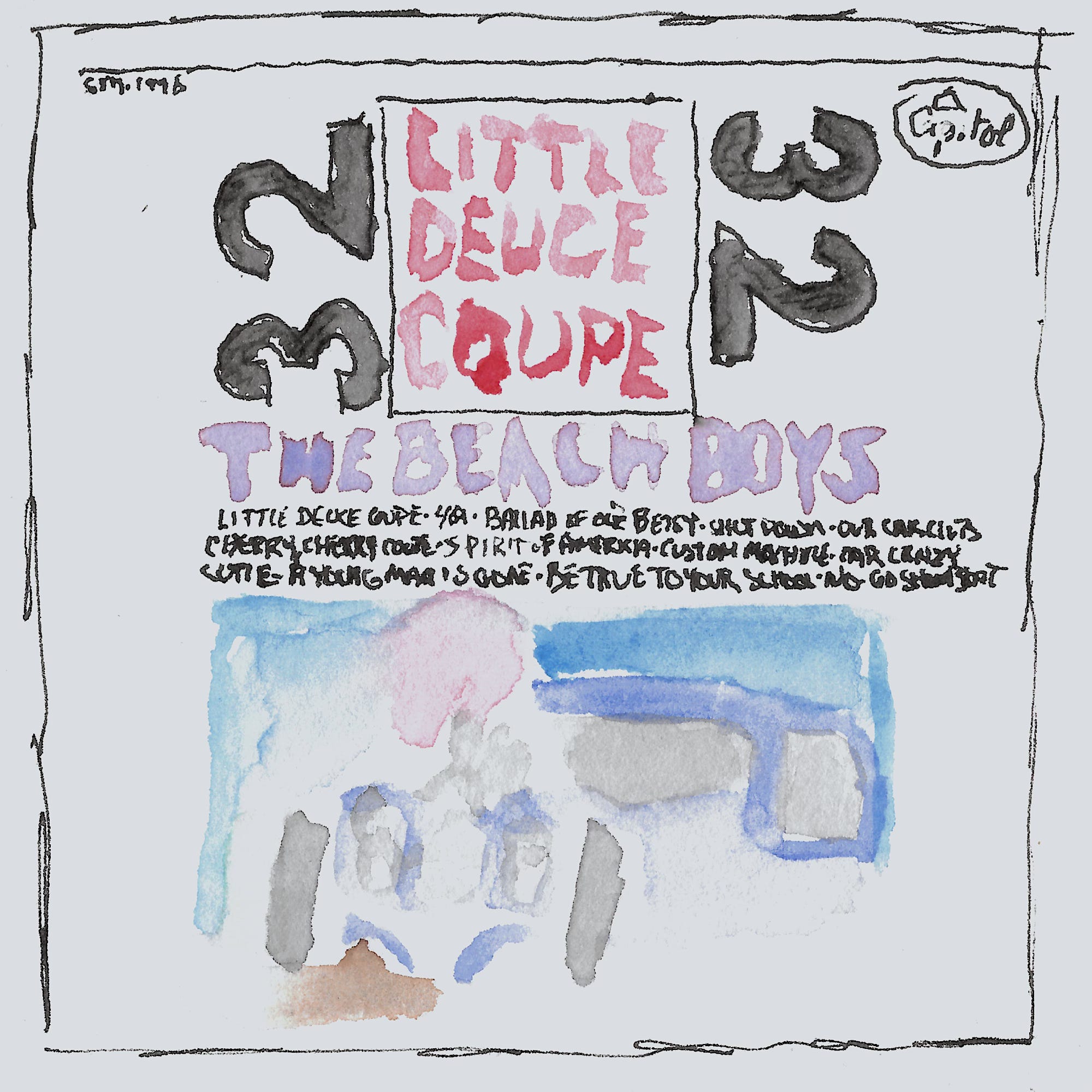
With the same approach as my previous post, I wanted to put together yet another tribute to a musician whose work I've loved and respected since my youth: Brian Wilson, famed for his role in The Beach Boys, passed away at 82 earlier this week.
At some point in your life, maybe you've encountered the same undecidable idiom that I have: good things come in threes; or, alternatively, bad things come in threes. I'm beginning to wonder if this is what the new "27 Club" looks like—not the sudden loss of an artist in the prime of their youth, but a slow unraveling of giants, each a keystone in the bridge between generations. Pharaoh Sanders made it close, but not quite. And now Wilson.
I’m still waiting for the third, to lose another legend.
Just like Sly Stone, Brian Wilson is a complex archetype for people to mimic. He did the whole rockstar thing, which I won't capture in full here: early success, innovation on the form, drugs, disillusionment, family trauma, rehab, late-career resurgence. But ultimately he helped to rewrite pop music from whole cloth, starting with simple songs about surfing and school and being a kid, and exploding those ideas of imagined California into something that resonated across the world—not unlike what another group would do decades later, updated for a modern scene.
Like many people, I heard "Little Deuce Coupe" coming through the speakers of a radio. I was in third grade, and we were in a Sunday School classroom in a summer daycare program. It was decked out with toys in bold primary colors, big bay windows, with a computer in the corner next to a beat-up boombox. The adults supervising us only had a handful of cassette tapes, and The Beach Boys were in heavy rotation. This one had to be dubbed from someone's collection, because the track listing doesn't match up with any greatest hits comp I have seen since.
I remember listening while waiting my turn to play Oregon Trail on the Macintosh SE, sunlight filtering through the high windows, the heat rising in that humid Midwestern way. “Kokomo” was on, sounding both exotic and eerie because of that '80's reverb, making me think that if there was a place called Kokomo, I didn't necessarily want to go there, afraid of what I would find. And then “Barbara Ann” came on with its bombastic ba-ba-ba's; “Surfin' USA,” which was near-impossible for us to comprehend as Midwesterners with only choppy lake waters in our milieu; and then a handful of forgettable songs about cars, with lyrics about the size of an engine block, something about a "cellunoid" for opening car doors. Suffice it to say, “Little Deuce Coupe" wasn’t the kind of music that I felt kinship with as a ten-year-old.
And in the following school year, I joined choir. I didn’t show any special aptitude as a choirboy; most of us didn’t. We sang silly songs like “The Flying Purple People Eater” and “Hello Muddah, Hello Fadduh”—even as a child I detested these; cloying in their repetition, and the absurd dance moves we were required to perform made them especially insufferable. But we also sang more normal pop hits, "Little Deuce Coupe" among them. I didn’t start drag-racing in the few months since school started, but the song made more sense to me now. Even with a roomful of rudimentary singers, the harmonies were something else—something otherworldly.
We performed regularly in nursing homes in my community, which I dreaded. My mom worked in one of them, in rehabilitation—teaching people how to swallow again, how to speak again. I’d visited her at work before, watching the quiet dignity with which she tried to help people whose bodies had failed them. I was terrified of those elderly people, of their drool, of the forms of their dysphonia when they tried to speak, of the confusing parts of their aphasia, of the eerie silences until their mouths caught up with their brains. No one had given me the language to talk about aging or when a body breaks; I had only the impulse to recoil from it.
But then, after we all filed into the annex and arranged ourselves, the atmosphere changed. As we started to perform I watched the faces of these strangers light up. Their eyes found something in the music, something familiar. They clapped along, did a slow shuffle; some of the more spry folks coupled up and danced closely. At least one person who could not speak full sentences was able to sing along, as if they never experienced the ischemia that took out their Broca’s area. And I think that might have been the first time I understood the power of this sort of performance, that music could do something words by themselves couldn’t.
There's something about inheriting someone else's pop culture—that of your parents, or the mass-media make for the generation who's currently in ascendance—that feels odd, unheimlich. The broad messaging is still discernible: there's still a preoccupation with trying to feel young forever, to avoid the slow fading of age. And for me, The Beach Boys, through this record, produced a time capsule that did just that—helping to carry forward cultural artifacts that never quite fit you, and watching them disappear one by one. In this case, this record came from the middens, almost relegated to a garbage dump when someone left it on the side of the road: I rescued it and then listened to both sides, the short songs moderately catchy but ultimately not my style or level of interest.
There’s a tendency I have, maybe overwrought, to think about the right soundtrack for moments like these. You might even suggest it's too on-the-nose since it's funerary, but the song to highlight from this record is “A Young Man Is Gone.” It's not by Brian or the Boys; it's a cover, but it's emblematic of the character of this collection. It is comprised of a lovely contrapuntal vocal arrangement with powerfully-executed voice leading, occasionally evoking almost medieval timbres--and some of the most corny, earnest lyrics you can find about someone who drag-raced to death. Though the words themselves aren't affecting, the music is a vivacious celebration of the performers--you can tell they're delighting in the intensity of the experience, even if it's a solemn one.
Back in the day, I didn’t know what a coupe was. But now, to paraphrase the lyrics of the song “I know what I got”. I’ll keep this one for two songs; that’s enough.
Verdict: Keep
Are you true to your school?