

High Line
SUSS; "Ursa Major"; from Amazon

Like so many children of my generation that were fascinated by Egypt, I was transfixed by the news that we could X-ray King Tutankhamun’s sarcophagus and learn more about that ancient, distant civilization. That was probably my first encounter with the idea of sifting through the middens of a society to construct a broader narrative—about how people lived, how they spent their time, what they chose to keep and discard. But a sarcophagus is hardly trash--it’s an intentional vessel to preserve something lauded and important.
When you grow up in the country, given over to quiet and relative freedom--no constant supervision, no steady stream of organized activity--you end up trying to find your own way, make your own map. And exploration, more often than not, begins to resemble excavation. The sepulchers I found!
The old schoolhouses scattered in the middle of nowhere were perfect in their decomposition. They marked the death of a way of life, a specific kind of culture and community, but they also offered glimpses into how children from a century ago might have lived. These buildings—brick, with tarps stretched across their roofs—were neglected antiques sitting alone in cornfields. No one seemed especially interested in restoring them or repurposing them beyond the occasional use as a shed or garage. Mostly, they were left to decay, slowly reclaimed by the surrounding landscape.
The main doors were usually sealed, boarded up from the inside. The windows were exposed, their shutters fallen into the dirt, revealing boards meant to keep people out. My first real glimpse of one came after prying two loose boards, sticking my nose in close enough to peer through: graffiti from a ten-year-old in 1906, possibly someone’s great-grandfather now. I marveled at the looping consistency of the cursive and found myself wondering about the life that child went on to live. Inside, a slate board still hung on the wall—perhaps it’s still there.
From there, it was only a few short steps from public infrastructure to private homes, more modern abandoned houses. When a farmer could no longer keep up with a mortgage, they might leave quietly, sometimes overnight, letting the bank reclaim the land and whatever stood on it. I never knew where they went, only that they disappeared. The houses they left behind were often managed in the barest sense by distant owners: a mowed lawn, a field cut back by someone with a scythe. Enough to maintain appearances, but not enough to bring the place back to life.
On long, aimless bike rides—Saturday afternoons with nowhere in particular to go—I would feel pulled toward these places. They rarely disappointed. Some interiors looked as though a family might return at any moment, sit down, and resume their lives. Others felt like accidental art installations, long before I had the language to describe them that way. I saw all kinds.
One house sat just off the main road, a kind of quiet rebuke to the slow encroachment of the new development just further down, a “No Trespassing” sign in the window. Inside, the floors had been cleared, and a makeshift privy stood in the front room. Shag carpet climbed the stairs from the kitchen, then looped impossibly back through a hole in the ceiling—something like a Möbius strip, as if the house itself had begun folding in on itself.
Elsewhere, the grass grew to my thighs. Door frames tilted off their axes. The air carried the dense, unmistakable smell of rot. The house, despite being ornate in an older style, was almost animate in its decay. In the living room, four televisions were stacked together, a monument to a kind of entertainment that no longer functioned. A worn couch faced them. In the foyer, a dust-covered dresser stood against the wall, and on top of it sat a cleaver, placed with unsettling deliberateness. It was the only object untouched by dust. I promptly left.
I’d scribble down my experiences and write some of the imagery into bad poems that, years later, I would submit to my college literary magazine for a resounding rejection. Eventually, I’d see the film Stalker, read Roadside Picnic and knew that I was on the same journey as the protagonist, looking for alien artifacts in a depopulated zone. But those eyesores and pockmarks on my memory, on the flat landscapes of my youth, are what brings me to SUSS.
For my money, SUSS is the preeminent modern act in what you might call ambient country. They draw on the familiar tools of your Merle Haggards or Johnny Cashes, but stretch them across the kind of expansive, droning soundscapes more often associated with post-rock. If you imagine a band like Explosions in the Sky, aged a bit, trading their Stratocasters for lap steels, you get somewhere close to the texture of it. The music is spare and austere, evoking that high, lonesome quality associated with Hank Williams’s tunes: something mournful, emotionally direct, yet seemingly meant for a small and attentive audience.
Through the song suites the band puts together, they give shape to the quiet darkness that sits beneath everyday life when you are removed from its constant noise, the kind of disturbed Americana that churns in the background when you watch a David Lynch movie. Had I encountered SUSS when I was first getting into this sort of sprawling instrumental music instead of Sigur Rós or Godspeed You! Black Emperor, I think I would have ended up centered in the same spiritual plane. There’s shades of Boards of Canada and slick 70’s guitar groups, and it wouldn’t be right to talk about the sonic world without bringing up the Apollo soundtrack. Ultimately what interests me most about this particular record isn’t just the music itself—the textures, the instrumentation, or even the trivia that one of the members was once in the B-52s—but the dual meaning of its title.
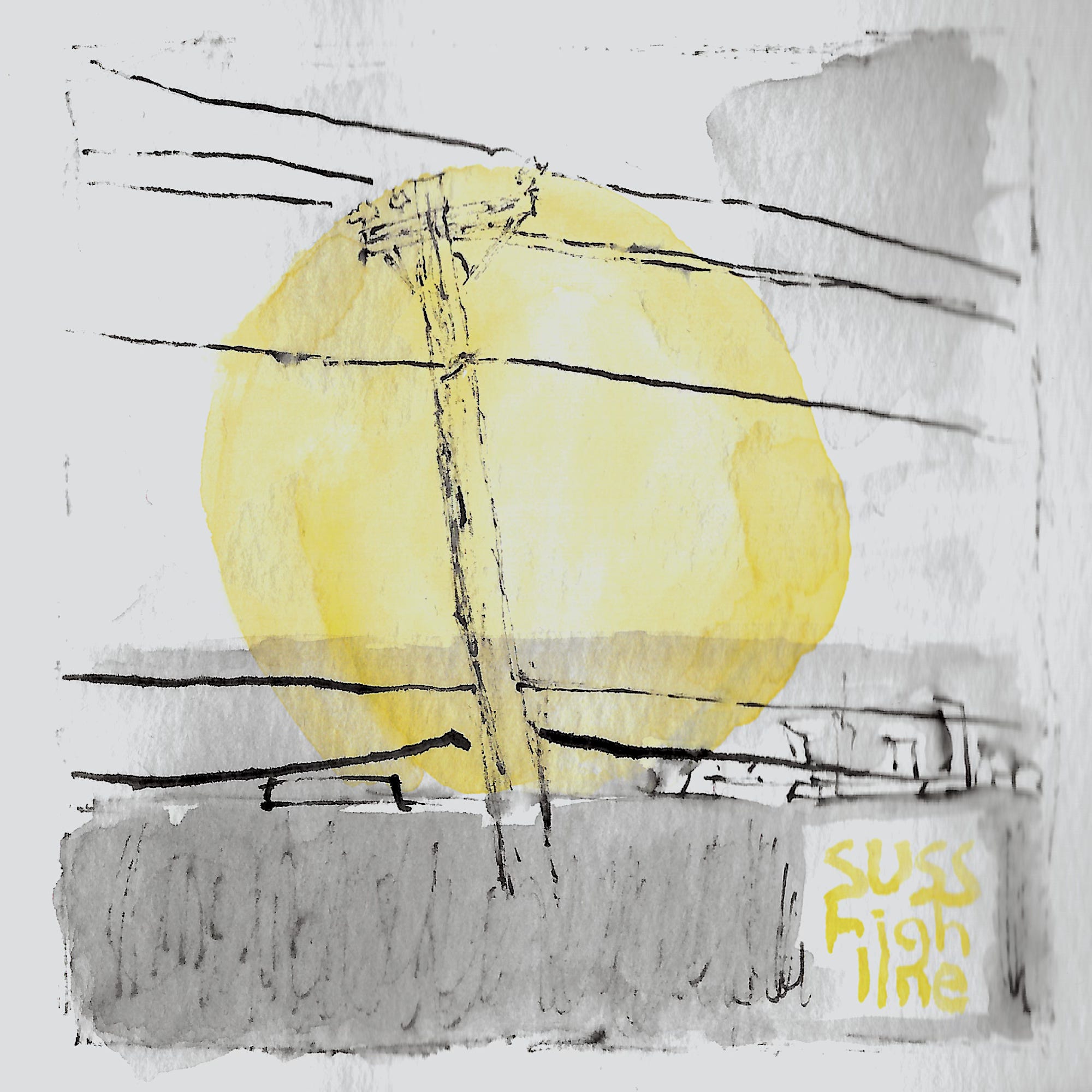
The cover shows a distant city, a massive power post cutting across the frame, suspended in a kind of moonlit stillness. It calls to mind “Wichita Lineman,” that twangy plaintive standard that cascaded through 1970s country conveying remoteness, the quiet sorrows of the working man, the never-ending road trip barreling forth into the horizon (and namesake for a couple of songs in this collection). But it also suggests the High Line in New York—a piece of abandoned infrastructure reclaimed and transformed into something communal. A space once defined by neglect becomes a place for walking, gathering, and lingering—something human again.
That transformation feels central to the music, and to those fragments of abandoned lives where I spent fleeting moments of my teenage years. It suggests that elegance is latent within ruin, that even the discarded, the long-forgotten, can be reconstituted into something meaningful. You can also just rot in place and take something as it is, like a little red schoolhouse in a field.
Verdict: Keep
Tell me about your time in a place you weren’t supposed to be.