


For a time, we lived in China. Our small city was too small even for unofficial categorial tier classifications—it wasn’t tier one like Beijing or Shanghai, tier two like Fuzhou, or tier three like Luzhou. It lived in the aspirational imagination of rural people that lived in remote villages as a stopover, when they had to find someplace with a train, a connection to a bigger world, to get where they were going.
Where we lived had two claims to fame according to Western history. First, it was almost 2,000 years old and for a time was an imperial capital. Second, Marco Polo visited once in the 1200s. As far as we could tell, after interviewing all of the elderly people that we could in the city, no Westerners, no foreigners had spent time there since.
And thus the people weren’t ready for us. We were curiosities at the most mild and celebrities at the most ostentatious. People would regularly point at us in the street, amazed by the surprise of our presence. Once when I was purchasing detergent, I knelt down to pick our preferred brand off the lower shelf and came up only to have a baby pressed into my arms, a prop with which I was supposed to pose while the parents could demonstrate that they indeed had met one of the rare foreigners that was supposedly circulating through the city. I was an auspicious token.
But one of the most strange stories of our time in China was when we were miscommunicated into performing for the Regional Badminton Association.
In our year there, we had a translator, a young man who was the only person with passable English in the city. He failed his English degree and failed all the way home and became the most proficient in this small community. Our fixer for the year. He was our best friend because he was the only person that we could talk to. He made so many things happen for us, whether it was contract negotiation or speaking to the bank manager or communicating with people at restaurants that we were vegetarian.
He also was very happy to introduce us to the cultural traditions of Chinese professional society. He was the one that told us that there is a tradition of teachers to perform their talents for other teachers as a bonding ritual. They might be singing a song, it might be drinking copious amounts of beer, it might be both. We went to one faculty meeting where there was a relay race and then I was somehow forced into a drinking competition with a teacher who was nicknamed “Horse” because his surname was Ma and he drank like a horse. This is an illustration of our typical escapades—performing baijiu consumption. Thankfully I didn’t have to smoke.
About halfway through the year, our translator told us that we would be performing a talent show for a meeting of teachers, that it would be a small crowd after school and that we should maybe practice a song to sing or something like that. He made it seem as if it was a simple affair, take place in a classroom and it would be meeting some people that were passing through town, just meeting with the headmaster.
We turned up that afternoon having run through “Dink’s Song” by Bob Dylan which was an interpolation of a traditional folk song made popular by the film “Inside Llewyn Davis”. Luckily I was playing it on guitar in those days; we had practiced it maybe three times together. My girlfriend knew most of the words but had a sheet of paper with lyrics just in case. I knew the chorus to sing along and the chords and that was going to be enough. Our translator came to fetch us and took us to the cafeteria, which doubled as a large auditorium. It turned out that all the teachers in the school were there, as was the entire student body, and probably a few hundred people we didn’t recognize at all. It was probably a thousand people total.
There were a collection of students on before us that were doing a synchronized dance number: a girl group complete with dance moves and singing at high intensity with pumping bass. Then they pulled out a stool and a pair of microphones for us. We were ushered from backstage, and got a moment to briefly introduce the song. Sadly, my girlfriend was about a half step, maybe even a full step high for the performance—we were not in sync at all. In retrospect, I am incredibly happy we didn’t try to do the David Bowie song we were thinking about, with the Seu Jorge arrangement. It would have been more challenging.
Nevertheless, we finished the song and stayed for one more act, sitting down back in the crowd. The next performance had some kind of crowd interaction, and threw gifts and tokens from the stage. A student I didn’t know elbowed me in the face when catching something, deviating my septum and knocking my glasses off—I still have breathing problems to this day. But then we ran away to our apartment, through the Hutong-style alleys, to hide away until the next school day.
How does this relate to Bob Dylan? There are so many incarnations of this man, whether the traditional balladeer, the Rimbaud poet, the electric apostate, the motorcycle exile, the billionaire Nobel laureate. For each of them, he never stays inside the role or the responsibility foisted on him: his identity becomes a costume for self-invention.
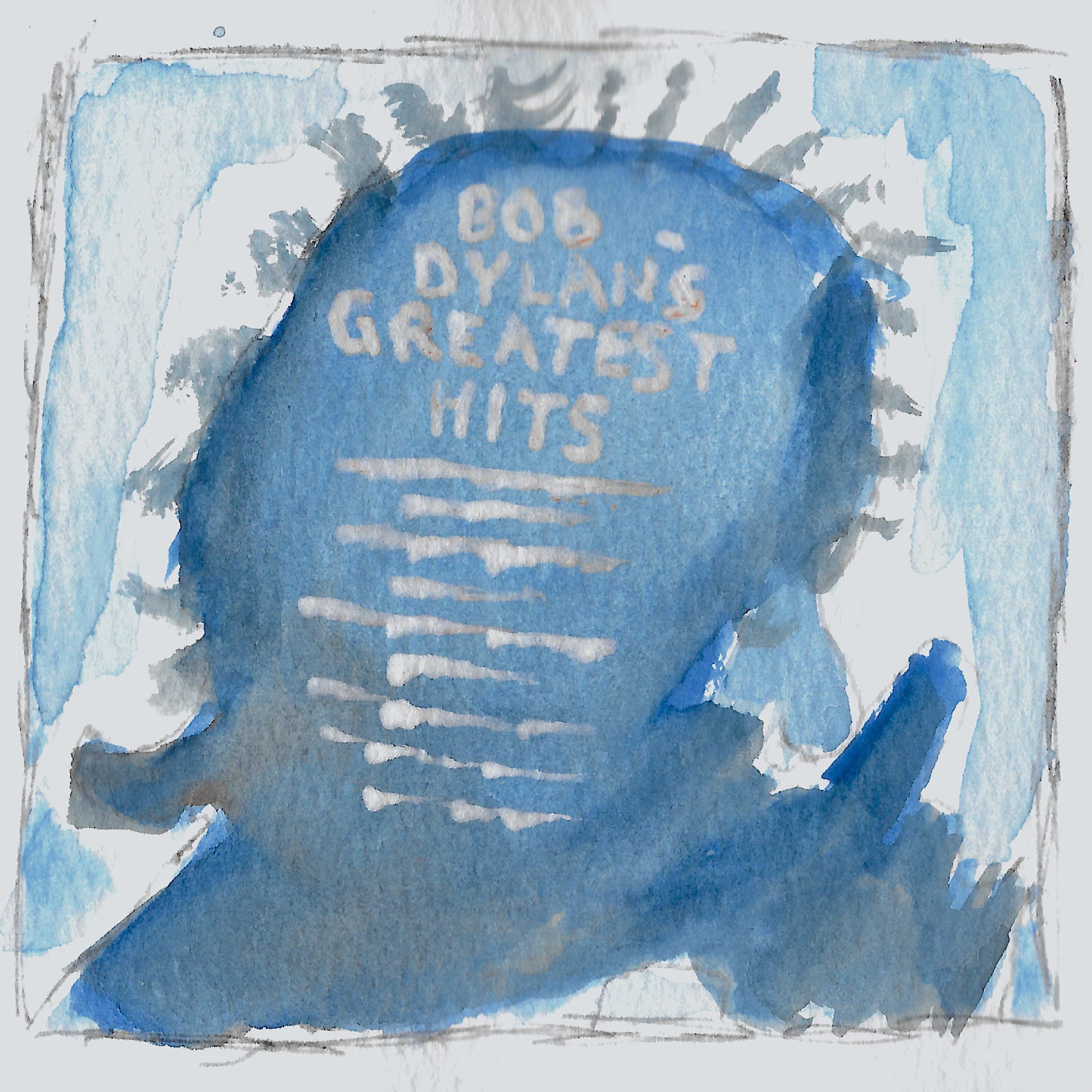
For me, the Greatest Hits record amplifies the best tendencies in Dylan’s songwriting, collecting his singles and stories and perspectives about American culture into a lasting volume. Each song, just like each incarnation of the man, shows the richness and possibility of the American dream—the complexity, the beauty, the points where it succeeds despite itself or fails on its own merits. And I suppose at the time in which we were there in China, the American dream was on the decline, and the Chinese dream was ascendant. I like to think there’s a Chinese Bob Dylan out there, somewhere. Maybe they will also make their way up from a remote backwater and capture the cultural imagination, trying on identities along the way.
Verdict: Keep
Is it you I’m looking for, babe?