

From L.A. With Love
Various Artists; "Kobwebs (The Gaslamp Killer featuring Gonjasufi)"; from eBay, via an overstock seller

I’ve been doing this thing for a while, so you think I would know, but—as I sit down to write this post—I’m confronted with a question: what is an album?
The roots of the album come from an analogy to another container, another form. It is based around the idea of the scrap book or the photo book. At that time in the history of recorded music, you couldn’t fit more than one or two compositions on a disc (about five minutes per side), and people were figuring out how they wanted to compile and market recorded music anyway, because it was so new. Somebody somewhere (a record executive with their eyes on making a buck) would take all of their related records—artists performing works in a similar genre, movements of a symphony—and pack them into this special collection of envelopes, bound together, and that bundle would be sold. Eventually, as the years wore on, as musicians started writing their own work and being auteurs of self-expression, rather than singing the contemporary hits of the moment, as innovations in the medium (like the long-playing record) would allow for longer-form compositions to be compiled together into one prepackaged collection, the album became the fundamental unit of musical cultural exchange after the song.
In that sense, the album started out as a compilation. In our contemporary world, we imagine a compilation to be distinctly different from an album, possibly because of the 1960’s and 1970’s turn toward singer-songwriter culture. People began to think of their collection of works as an artistic statement and release records that had deep, intentional reflections of their internal life. But there were still record labels selecting songs and curating collections—some of them even bring together different pieces of music on a particular theme as an artistic statement. When these things survive, they can give us an excellent lens into particular musical movements or subcultures, carrying forth their ideas into the present day.
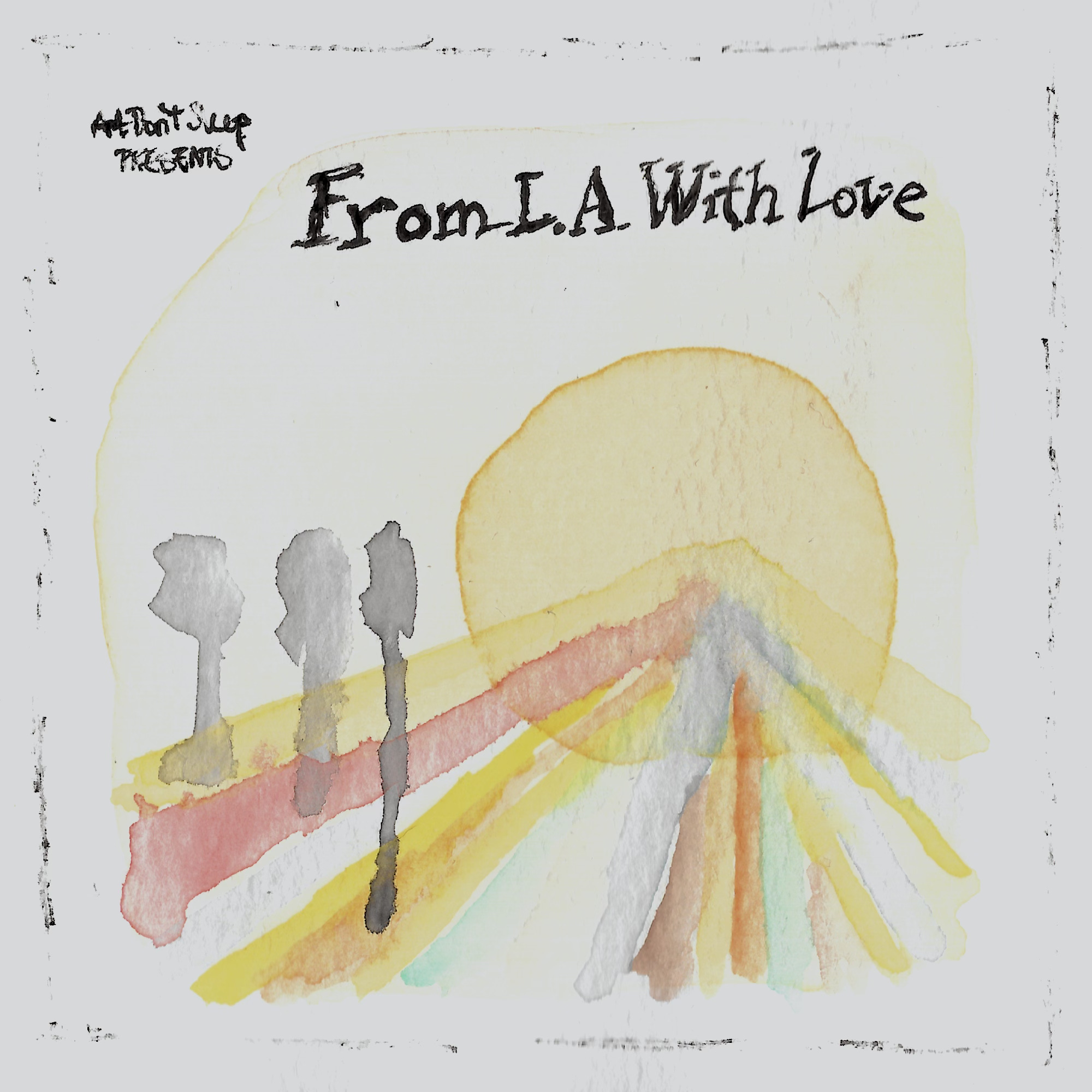
This selection, From L.A. With Love, captures a scene and a window of time. In the same way New York in the early 1990s was a veritable Galápagos Islands devoted to stylistic exploration of what hip-hop could do (Digable Planets being one such example), the LA beat scene of the mid 2000’s exhibited its own kind of founder effect: musicians who had come from elsewhere or were local—conservatory, film school, crate diggers, loop finders—were brought together to make sounds that were just straight up weird, trying to impress or surprise one another. There were folks who dug only in the spiritual jazz world and made their own variations on a theme but inflected with dub; others would go deep into the archive of Middle Eastern psych guitar records. Either way, it was forward-thinking and way out there.
The thing that’s particularly curious about this subculture, this music: so much of it was spread through online platforms as loose tracks. When it was being made, people were too concerned with getting their ideas out there to sit down and document their work in a structured, rigorous way. Myspace and Soundcloud releases ruled the day. Often, the music tends toward abbreviation: a sample flipped from an old jazz record, put through its paces, and then stopping short; a live cut when a beatmaker was doing some woodshedding at a local bar, fading into the next song; whatever the 20th century synth world’s core contrapuntal compositional structure is (fast arpeggios over a chopped-up amen break, indiscernibly-complex electronic machine malfunctioning in the background).
That’s not to say every song on this record is a short one. There’s at least one two-chord vamp that wouldn’t be out of place on a Can record, Follow that up with a smoky, sleepy jazz vocal sounding like an alternate spin on Massive Attack, but a particular kind of jazz freak out underneath when the singer steps away from the mic and the Rhodes is really able to get free. And the final piece on the final side of the final record (thank goodness we got LPs otherwise there would be dozens of these things!) could easily be the sprawling elegant music which sets the scene for a 1940’s film: tight harmonies in the woodwinds, strings, perhaps chimes in the background. It’s the combined powers of Carlos Niño and Miguel Atwood-Ferguson, two giants of the era (then and today), two pillars of the community coming together to make something beautiful.
Sometimes, there are elements of our artistic oeuvre that do not clearly fit in perfectly—things we might be proud of, and want in the broader corpus of our work but there’s not the same kind of consistent through-line for this thing as with the others. This is the value of the compilation now, and why it endures. It collects the footnotes of musical history and elevates their status so we can weave them into the central narrative if we so choose.
Verdict: Keep
What’s the first track on the compilation for your scene?