

Death and the Flower
Keith Jarrett; "Death and the Flower"; from a barn sale in central Ohio

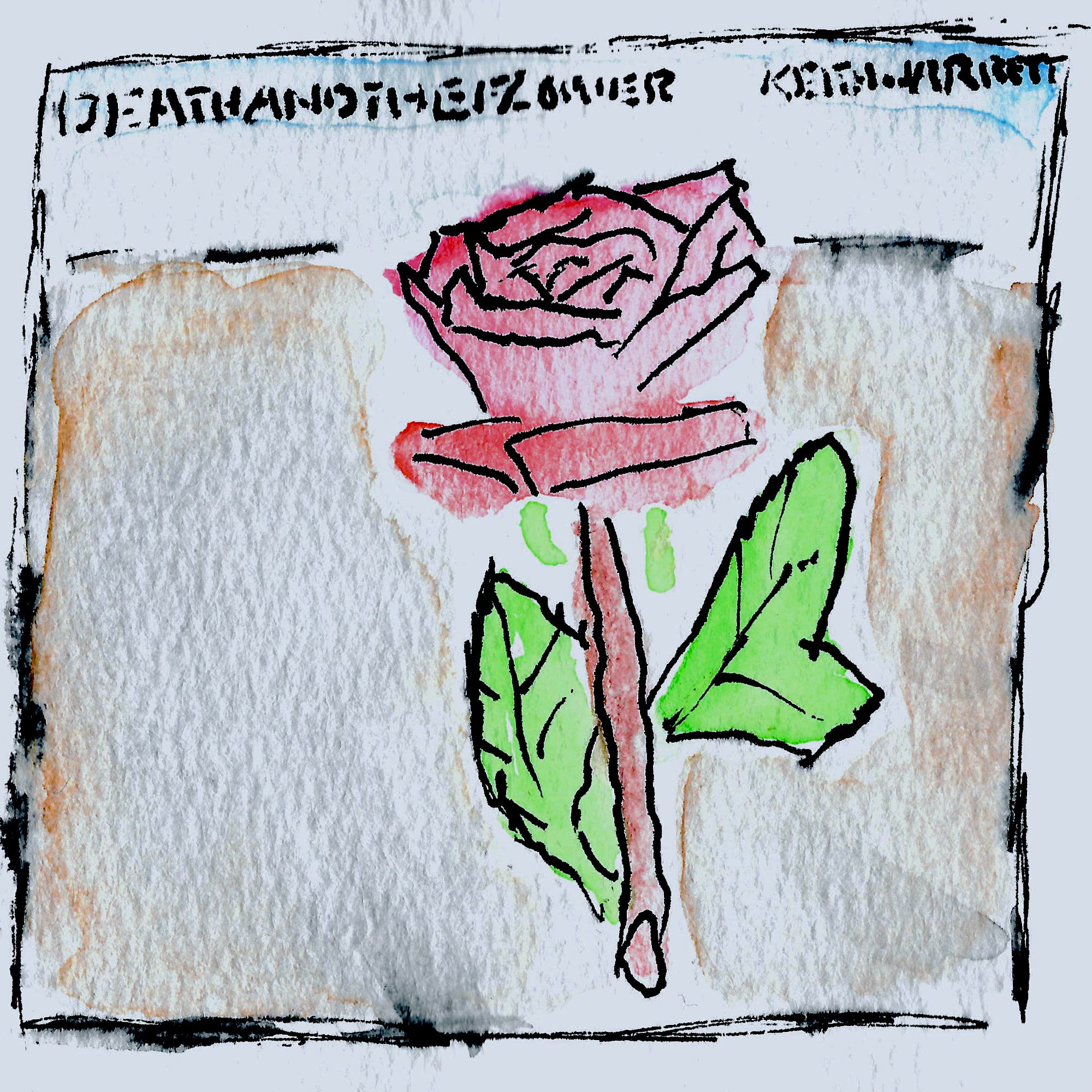
Yet another Keith Jarrett record from the barn sale. I have already written about my discovery of his work, pulled from a moldering and undignified resting place, given attention and a new home after decades. I have also written about my desire to turn my home into an art gallery, to help cultivate a focused listening experience: deep engagement, attention, and immersion in the music. If ever my dream were to come true, if one day I found myself running a jazz kissa out of my house—just as a delightful EDM fan ran her breakfast restaurant—there would be some rules: when the needle drops, no noise except soprano saxophone, shuffling sleeves, record jackets, the crisp quiet drag on the odd cigarette, and the clinking of glasses. In that world Death and the Flower would be in the first set that I play. And, of course, my selection skills as a DJ speak for themselves, so you know it’s worth listening to.
This record emerged from Keith Jarrett’s early‑to‑mid 1970s American‑quartet period, where his writing fused post‑Ornette Coleman free jazz, hymn‑like lyricism, and “world music” inflections rather than the later standards‑trio or classical‑recital focus. It came out in 1974, right in Jarrett’s most prolific 1970s stretch, when he was simultaneously developing the American (experimental, rhythmic) and European (melodic, atmospheric) quartets and his long solo concerts. This is from a window of time in his career where he was overflowing with ideas, with sound, and the lava inside was just beginning to bubble up, culminating in the eruption of 1976: The Köln Concert, Mysteries, Byablue, and Songs: The Early Bird.
And you can sense this same kind of frothing and churning across the songs on this record as well. The title track in particular is a long, suite‑like piece (around album‑side length) with slowly-evolving sections, strong modal and folk‑like themes, and extended collective improvisation. It’s a slow burn, with quiet percussion leading us into and out of pretty much every section. In many cases the listener could mistake the jangling bells and cabasa (or shekere?) for a field recording, until the music eventually lurches into a film noir film cue, and then a New Orleans funeral parade jam—an impossible-to-articulate-effectively-with-words ebullient sorrow. Or joyful melancholy. Regardless, haunted.
“Prayer” begins as a mournful bass and piano duet, with a midsection sounding like Steve Reich phasing with a bass solo underneath. The moments where they’re perfectly contrapuntally-aligned, like around five or eight minutes into the composition, are like something Dawn of Midi would produce decades later. “Great Bird,” for me, is merely an okay bird for most of the piece—it mixes the broader arc of of “Flower” with the lament-like aspects of “Prayer,” but there are parts (specifically around 4:50) where the combination of the shaker and the talking drum conjure Don Cherry—I find myself half-expecting his sing-song baritone like on “Brown Rice”.
Something was in the water in the 1970’s which caused people to think more about their ambient sonic environment. It’s a bit of a stretch to directly link Death and the Flower (or any of Keith’s 1970’s works) to Brian Eno’s Music for Airports in terms of intent, but I believe the work both artists made during this time came from a similar core. It feels like the sound itself had the desire to build atmosphere through repetition, layers of melodic fragments cascading overtop one another, that this property was emergent not just from the performers but from the artifact of the recording, its fixity in the medium. Maybe it was the pseudo-psychedelic hangover of the moon landing, the transformative ennui of the modern era, or the ability for people to listen to music at high quality at home, but so many bands and performers were hitting their creative stride and playing with this tendencey.
Eventually we’d hit the 1980’s and the musical trade winds would shift, but—if nothing else—this record is a reminder that atmosphere never really dissipates. Unlike the smoke in a kissaten.
Verdict: Keep
What are you going to play at your inaugural café opening?