

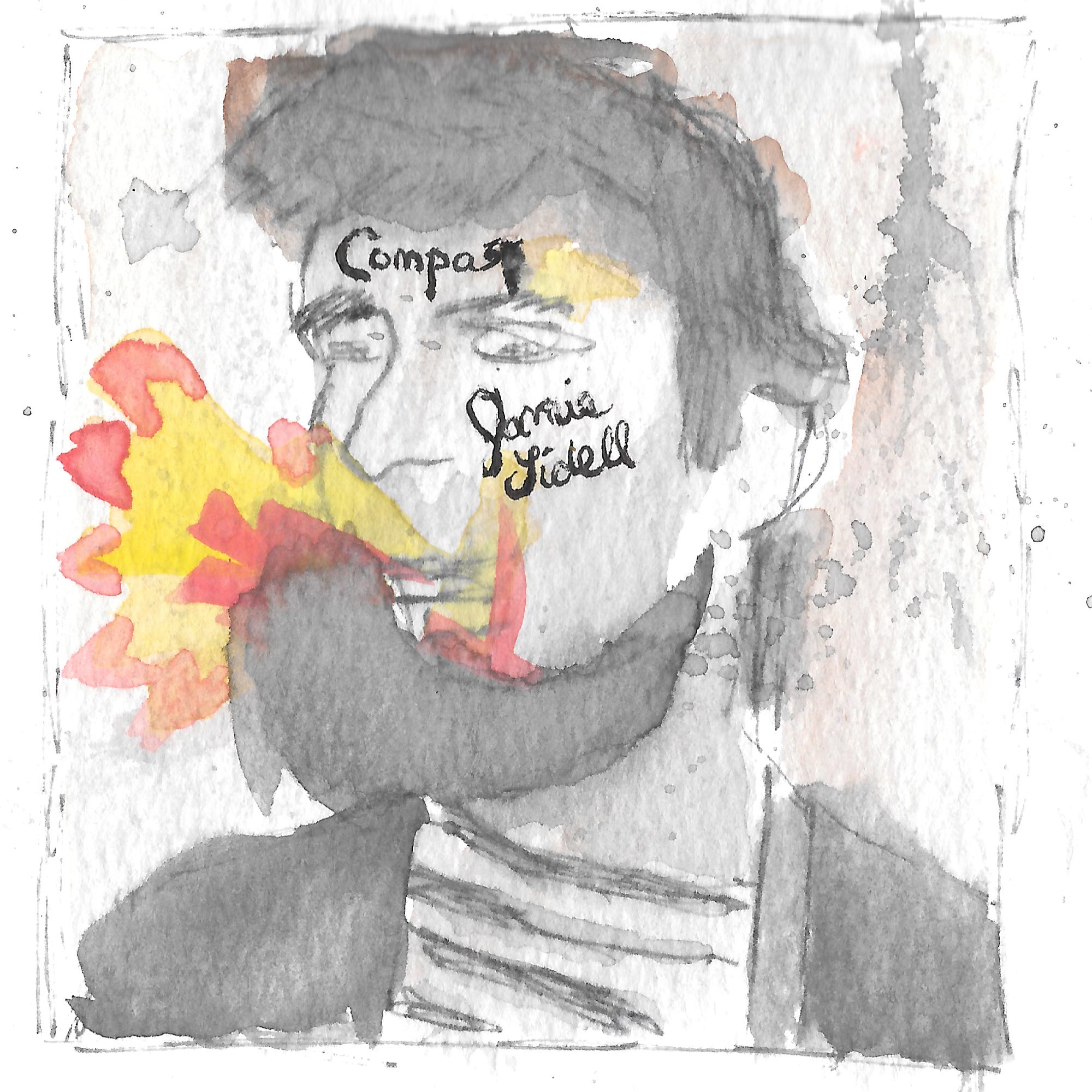
Compass
Jamie Lidell; "Completely Exposed"; from Allied Record Exchange

I had almost written Jamie Lidell off as just another soul musician. I heard “Another Day,” the single from his album Jim, for the first time while sitting at the newscaster’s desk in the school’s annex, ostensibly working on a video production package, but actually watching music videos. I wouldn’t know this until later, but he pivoted to a trad soul Motown-influenced record just when there was a social resurgence of that style, with Amy Winehouse and Sharon Jones leading the way.
But something spoke to me in the music. It sounded like Dick Van Dyke sliding down the bannister and bursting into song, a Saturday morning musical revue, jubilant and effusive. I found it compelling enough to go digging in my tape-trading circles.
After I got some early pre-YouTube performance videos of his live set, I discovered that he made most of his sound by doing live looping, using software he had written himself, building songs up layer-by-layer. I was listening to Medulla by Björk around the same time, a record famous for its all-vocal performance. In Jamie’s live set, there were shades of Andrew Bird’s tuneful melodies and Rahzel, a beatboxer who was all over the Björk record, bringing deep bass and percussion with just his voice and microphone technique. I was smitten.
Jamie lived a life I could have only dreamed of—intense electronic bona fides from his time in Super_collider, a band named after a software tool for programming music; favored son of Warp Records in the window of time that they were just beginning to bring other-genre acts to their roster; opening for Prince and Prodigy; honed his craft in early-2000’s Berlin, before Berghain became Berghain. As far as I could tell, only Stevie Wonder pioneered a similar kind of dramatic reinvention when he leaned into synthesizers and rebuilt his sound. Just like Stevie, Jamie had mastery of the tools—he could produce, orchestrate, record, and perform by himself.
And he decided to lean into that capability by rejecting it entirely.
Again, we fast-forward from the near-end of high school to the near-end of college. The iPhone came out, YouTube exploded in popularity, something fascinating was happening in Brooklyn (as evinced by this compilation), and Grizzly Bear was on the ascent. I learned that Beck, a weird dude, was doing a weird project where he learned and performed an album with a bunch of musician friends. They covered Skip Spence’s Oar, famously challenging, dark music, but similar to other music I loved. I noticed Jamie’s familiar face in the video and was curious what he had been up to.
It turns out he had been working on “Completely Exposed,” workshopping it in live settings. Since it’s the opening track of the album, it reminds us that we’re going to be in for something a little bit weirder than we were otherwise expecting--it begins with beatboxing, white noise filter sweeps, and distorted vocals before panoramically expanding. The song is strikingly present, a declaration of vulnerability in the lyrics and the way that Jamie’s voice sits uncomfortably close to the listener. Chris Taylor and Beck do some amazing work here to make the album sound lived-in and present, avoiding audible use of auto-tune across the record, a bugbear for critics and other musicians alike during the time period (Jay-Z would release a song called “Death of Autotune” in 2009). You hear effort, breath, and the strain of holding a line together across the entire record—a deeply human choice in a moment where technology was surging.
People think of this moment in history as the beginning of a period of revolution—society was beginning to transform as more people moved onto the internet, and there would be endless ripple effects. There’s so many sacrosanct guideposts that I could point to on this pilgrimage—Arab Spring in 2010, the same year as this record; Occupy Wall Street the next year; Black Lives Matter and Gezi Park Protests in 2013; the list goes on. The important thing to highlight is that none of those political movements were successful due to the use of new media forms; instead, any attention that they might have held onto over the years was likely due to a successful focus on generating people power. Technology promises connection but voice delivers it.
Of course, I wasn’t thinking about Arab Spring when I was listening to this album for the first time. I was thinking about breathing, about information theory—what can be conveyed through a voice, through the vibrations of folds of flesh, from the small pockets of air that carry a message that are irreducible to the message itself. The broader story the song “Compass” is trying to guide us towards, and indeed, the focus of the entire album, is to return to human connection. In a rapidly changing technological landscape, it’s the voice, the body, and the collaboration with others that truly point us home. Listening to someone with total creative self-sufficiency—one person, nothing in the way, augmented by tools—working with others, I realized that our best work emerges when technology recedes and we lean into the human.
Verdict: Keep
When were you last completely exposed?