

Another Green World
Brian Eno; "St. Elmo's Fire"; from Goodwill

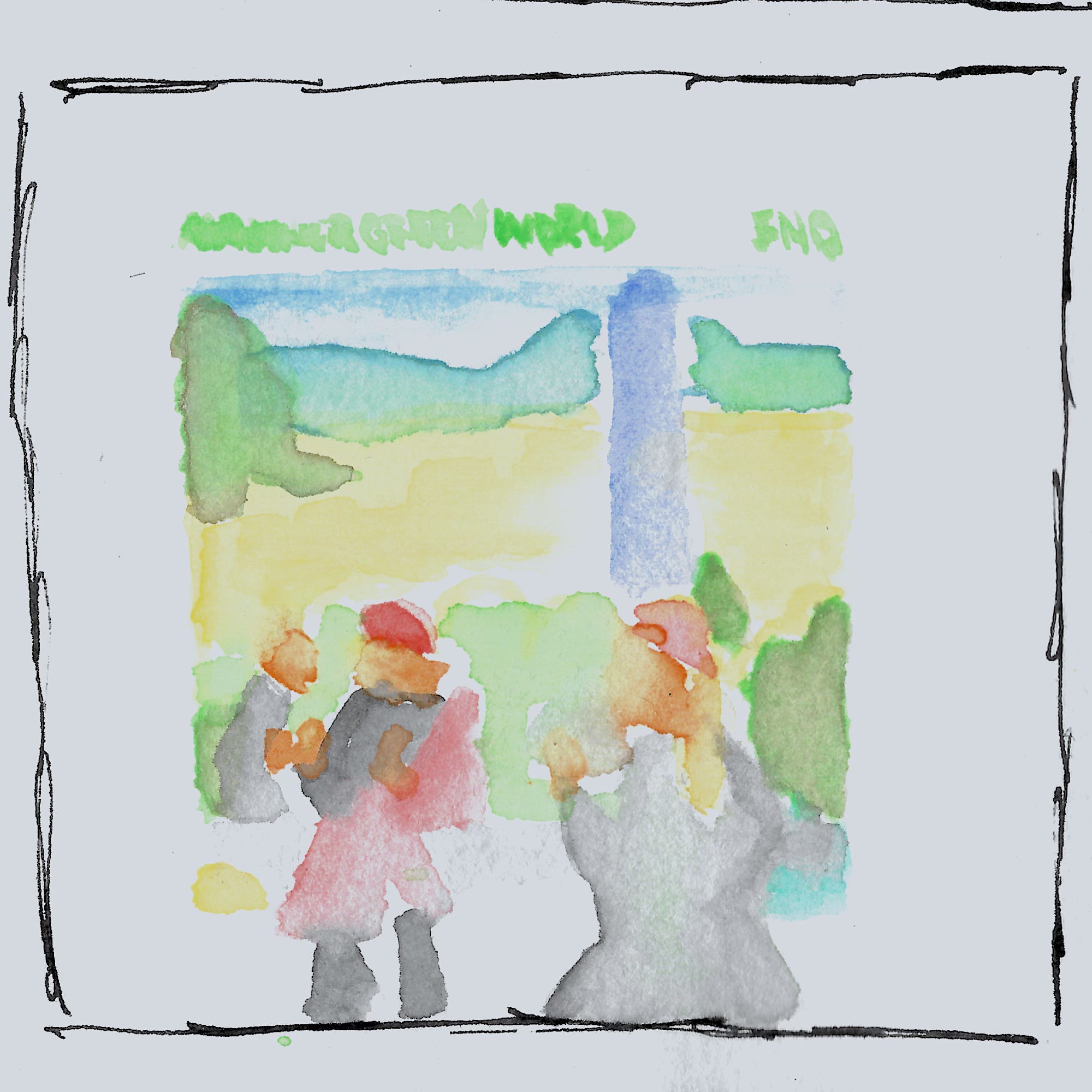
In my more brilliant moments, people tell me that I'm pretty good at coining a phrase that sounds like it came from somewhere else, saying it with such confidence that it seems like it's already used in common parlance. Brian Eno's pretty skilled at that too—he's the person that originally said that The Velvet Underground & Nico sold only a thousand records, but all the people who bought that record started bands.
So, by process of analogy: if Helen of Troy is the face that launched a thousand ships, and The Velvet Underground & Nico is the record that launched a thousand bands, Another Green World is the record that produced a thousand producers. It quietly reshaped the possibilities of what a solo album could be. It hints at what could have been if Eno had leaned deeper into weird pop songwriting instead of steering into ambient music and production. Would he still have been the Svengali behind Achtung Baby and Remain in Light? Hard to say. Thankfully, we live in the timeline where he gave us both, and stayed on stage for a moment before disappearing behind the boards. And then he went to the moon.
In a way, this collection has always felt like one of the strange short books in my personal library. You know the kind—experimental, exploratory, the kind of thing you put together to work something out, semi-publicly. Eno excels at that mode. When he's producing other artists, he sets systems in motion, lets them run, and sees what unfolds. When he's putting together his own material, he's (seemingly?) more free with the rules he puts in place.
Eno is backed here by a star-studded cast of collaborators, but what makes it special is the quiet gravitational pull of the thing, the clear intention of the person who’s bringing together all these disparate people. Another Green World is his first substantive foray into solo artistry post–Roxy Music, and while it’s arguably his most “accessible” early album, it’s still gloriously bizarre. This is due to the combination of instrumental pieces acting as bookends to (something resembling) singer-songwriter material. They borrow the vocabulary of pop only to stretch it into unfamiliar forms, filtered through Eno’s offbeat sensibilities and techniques. For example, take “St. Elmo’s Fire”: the ostinato piano fifths in the bass is almost punk in the simplicity of the lick, with Robert Fripp’s guitar solo sounding like it could be going backwards and forwards at the same time, straight out of King Crimson. These aren’t traditional pop songs, but they end up having mass appeal anyway.
Even the album’s cover—-a blocky, pastel-colored portrait—feels uncannily like a '90s Corporate Memphis graphic, but intentionally selected because of that uncanny valley between art auteur and accessible audience. In my memory, it's a subsection of a painting by a close collaborator, but who knows. Like the album, the painting hints at classical structure while abstracting it completely. Clean lines, ambiguous shapes, saturated spaces; it’s a perfect fit: a record that erases the borders between ambient and pop, fronted by a painting that erases the borders between classical portraiture and design for mass culture, the world of possibility that you see in the borrowed visual language with Boards of Canada, evocative of some grand governmental project to make design for the masses.
Personally, this record is tangled up with my own early attempts at recording. When we were working on my college band’s album, Another Green World was on repeat in the background, alongside Grizzly Bear, Fleet Foxes, Radiohead, Steve Reich and the other music of the time. I was visiting my parents between places, moving my gear out of the city and into temporary storage. The basement cubicle that had once been my childhood computer nook where I spent hours on forums was now crowded with upholstery tools from my mom’s projects. I carved out a little square of space and set up what I could.
I’d just bought my first reel-to-reel machine at a garage sale—maybe the first of its kind ever used in our corner of the state—and was experimenting with tape loops, curious about this old form. One night, midnight or later, I’d plug a pawnshop guitar and a borrowed amp straight into my interface to avoid waking anyone up. I had resolved to make a song on guitar without any chords or melodies. I’d shake the amp, strike it, try to tease the richest possible spring reverb from its cabinet. I layered loops from the tape that came with the machine, no idea what was on it. I sang some strange harmonies. Then I added snare drum tracks and tambourine in the morning, after the house stirred.
That song—kinetic, loping, textured—ended up being a demo that would eventually be reshaped for our lone record. And though I wouldn’t have called it “Eno-esque” at the time, the process was unmistakably his: exploratory, open-ended, based around capturing an effervescent, ethereal idea and committing it to fixed form. One person, awake while the world slept, building something unnameable from scraps and static.
That’s what Another Green World means to me: a strange little record that helped me make something of my own. Even though I don’t go back to it frequently, it still looms large.
Verdict: Keep
Would you come running to tie my shoe?